Anti-modernism
Radical Revisions of Collective Identity
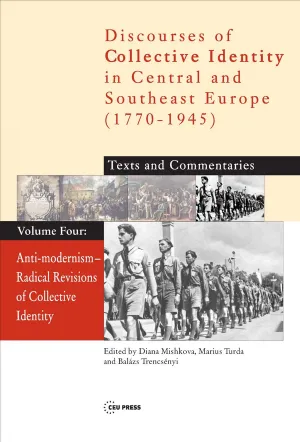
The last volume of the Discourses of Collective Identity in Central and Southeast Europe 1770–1945 series presents 46 texts under the heading of "antimodernism". In a dynamic relationship with modernism, from the 1880s to the 1940s, and especially during the interwar period, the antimodernist political discourse in the region offered complex ideological constructions of national identification.
These texts rejected the linear vision of progress and instead offered alternative models of temporality, such as the cyclical one as well as various narratives of decline. This shift was closely connected to the rejection of liberal democratic institutionalism, and the preference for organicist models of social existence, emphasizing the role of the elites (and charismatic leaders) shaping the whole body politic. Along these lines, antimodernist authors also formulated alternative visions of symbolic geography: rejecting the symbolic hierarchies that focused on the normativity of Western European models, they stressed the cultural and political autarchy of their own national community, which in some cases was also coupled with the reevaluation of the Orient. At the same time, this antimodernist turn should not be confused with rightwing radicalism—in fact, the dialogue with the modernist tradition was often very subtle and the anthology also contains texts which offered a criticism of 'modern' totalitarianism in an antimodernist key.
Redacteuren
Ahmet Ersoy is lecturer at the Department of History, Bogaziçi University, Istanbul.
Michal Kopecek is a historian working at the Institute of Contemporary History, Czech Academy of Sciences. He specializes in the comparative intellectual history of East Central Europe, with a focus on nationalism, human rights, constitutionalism, and post-1989 liberal, democratic, and illiberal transformations.
Balázs Trencsényi is a Professor at the Department of Historical Studies of Central European University in Vienna and Director of IAS CEU in Budapest. His main field of interest is the history of political thought in East Central Europe. Since 2022, he has been co-directing the Invisible University for Ukraine.
Vangelis Kechriotis is lecturer at the Department of History, Bogaziçi University, Istanbul.
Marius Turda is Professor and Director of the Centre for Medical Humanities at Oxford Brookes University.
Maciej Górny is Research Fellow at the Institute of History of the Polish Academy of Sciences in Warsaw and Centre for Historical Research in Berlin.
Diana Mishkova is a historian of the Balkans / Southeastern Europe and director of the Centre for Advanced Study Sofia. She has published extensively on the history of historiography, conceptual history, the history of nationalism and modern political ideas, national identities and identity politics in Southeastern Europe