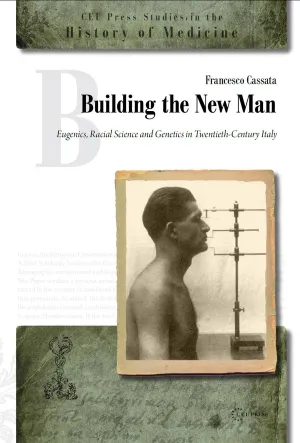
Francesco Cassata
Building the New Man
Eugenics, Racial Science and Genetics in Twentieth-Century Italy
Based on previously unexplored archival documentation, this book offers the first general overview of the history of Italian eugenics, not limited to the decades of Fascist regime, but instead ranging from the beginning of the 1900s to the first half of the 1970s.
Discusses several fundamental themes of the comparative history of eugenics: the importance of the Latin eugenic model; the relationship between eugenics and fascism; the influence of Catholicism on the eugenic discourse and the complex links between genetics and eugenics. It examines the Liberal pre-fascist period and the post-WW2 transition from fascist and racial eugenics to medical and human genetics. As far as fascist eugenics is concerned, the book provides a refreshing analysis, considering Italian eugenics as the most important case-study in order to define Latin eugenics as an alternative model to its Anglo-American, German and Scandinavian counterparts. Analyses in detail the nature-nurture debate during the State racist campaign in fascist Italy (1938–1943) as a boundary tool in the contraposition between the different institutional, political and ideological currents of fascist racism.
Author
Francesco Cassata is Professor of Contemporary History at the University of Genoa. He has written extensively on the history of racism, eugenics, genetics, and molecular biology. He serves on the Board of Directors of ComFas (the International Association for Comparative Fascist Studies) and is co-founder, with Guri Schwarz, of CENTRA – the Centre for the History of Racism and Anti-racism in Modern Italy. He is author of Racism and Antisemitism in Fascist Italy: The Politics, Ideology, and Imagery of “La Difesa della razza” (2025), and Building the New Man: Eugenics, Racial Science and Genetics in Twentieth-Century Italy (CEU Press, 2011).